Closing support services
Build a preparation layer your closing team can inspect.
Choose a bounded support lane, keep authority with qualified owners, and make every handoff visible through sources, status, evidence, and escalation.
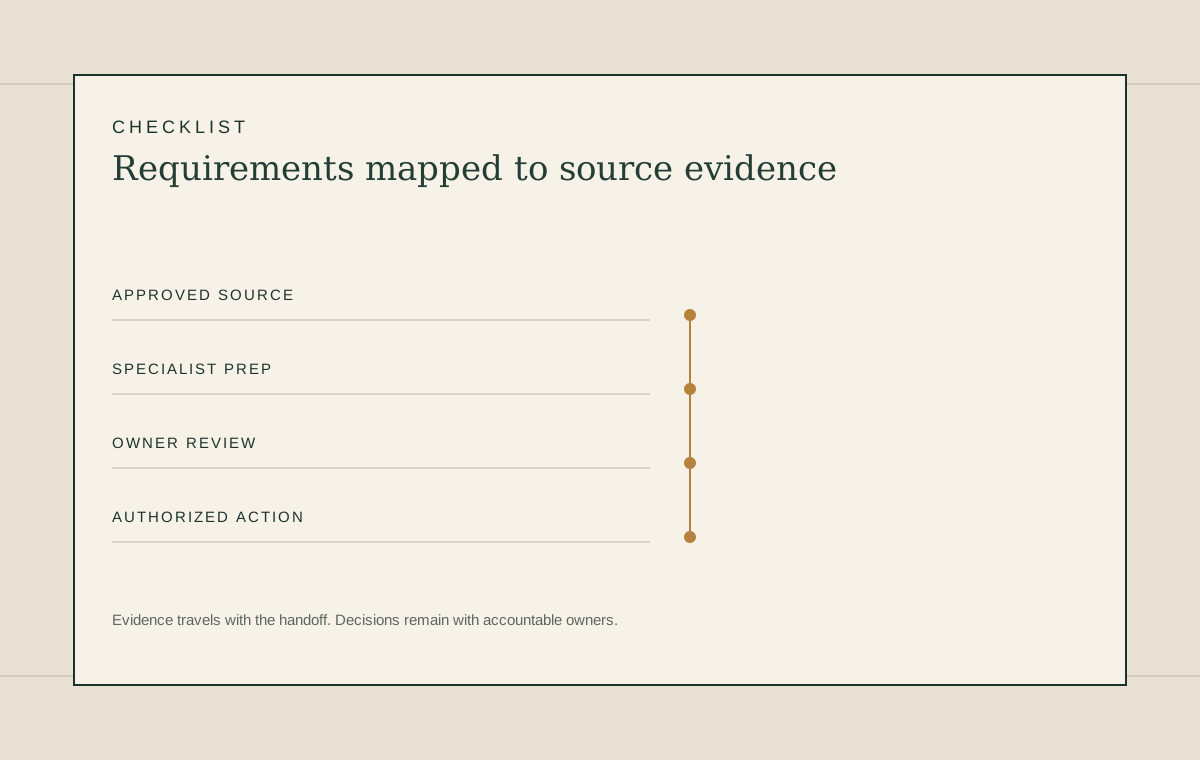
The complete service system
Six distinct queues. One accountability model.
Service 1 of 6Closing checklist support
Maintain review-ready requirement lists for each transaction.
- Prepare closing checklists
- Track required items
- Record completion status
- Escalate missing conditions
Review scope and boundariesService 2 of 6Document coordination
Organize approved closing records and stakeholder requests.
- Index closing documents
- Track approved requests
- Check document status
- Flag conflicting versions
Review scope and boundariesService 3 of 6Stakeholder update support
Prepare approved communications around milestones and exceptions.
- Prepare status drafts
- Record contact outcomes
- Route substantive questions
- Escalate sensitive issues
Review scope and boundariesService 4 of 6Date and milestone tracking
Keep critical dates visible across the closing workflow.
- Maintain milestone records
- Prepare reminder queues
- Document schedule changes
- Flag timing conflicts
Review scope and boundariesService 5 of 6Closing file preparation
Assemble organized files for accountable review.
- Prepare review packets
- Check required fields
- Maintain source links
- Document unresolved items
Review scope and boundariesService 6 of 6Post-closing records support
Maintain final records and approved follow up after closing.
- Index final documents
- Track approved delivery
- Maintain archive status
- Escalate missing records
Review scope and boundariesHow to choose
Start where uncertainty is expensive.
Choose a frequent queue
Prioritize work that repeats enough to document and review. An occasional ambiguous task is a poor first delegation lane.
Choose a visible output
The owner should be able to confirm what was checked, which source was used, and what remains unresolved.
Choose an available reviewer
A specialist can prepare and coordinate, but a qualified owner must remain available for exceptions and final acceptance.
Service planning questions
Before you define the role
Can one specialist cover several service lanes?
Yes, when the workflows share systems, source rules, and review ownership. Begin with one lane, prove the handoff, then expand intentionally.
What must stay with licensed or authorized personnel?
Legal interpretation, title and escrow decisions, settlement approval, notarization, identity verification, funding, wires, disbursement, signatures, and final close authority remain with qualified owners.
What should we bring to a consultation?
Bring one representative workflow, its source systems, current owner, completion standard, common exceptions, and the review evidence your team needs.
Not sure which lane comes first?
Bring the queue that creates the most search, follow-up, or status reconstruction.
Map the first support lane Closing SpecialistPowered by StealthAgents